Salon Booths for Rent vs Suite Rentals: What Each Really Costs
Booth rent vs suite rent in 2026: typical weekly and monthly rates, the costs on top of the rent, and the income math that decides which one pays off.
Published by Cosmo Salon Studios
October 2, 2026
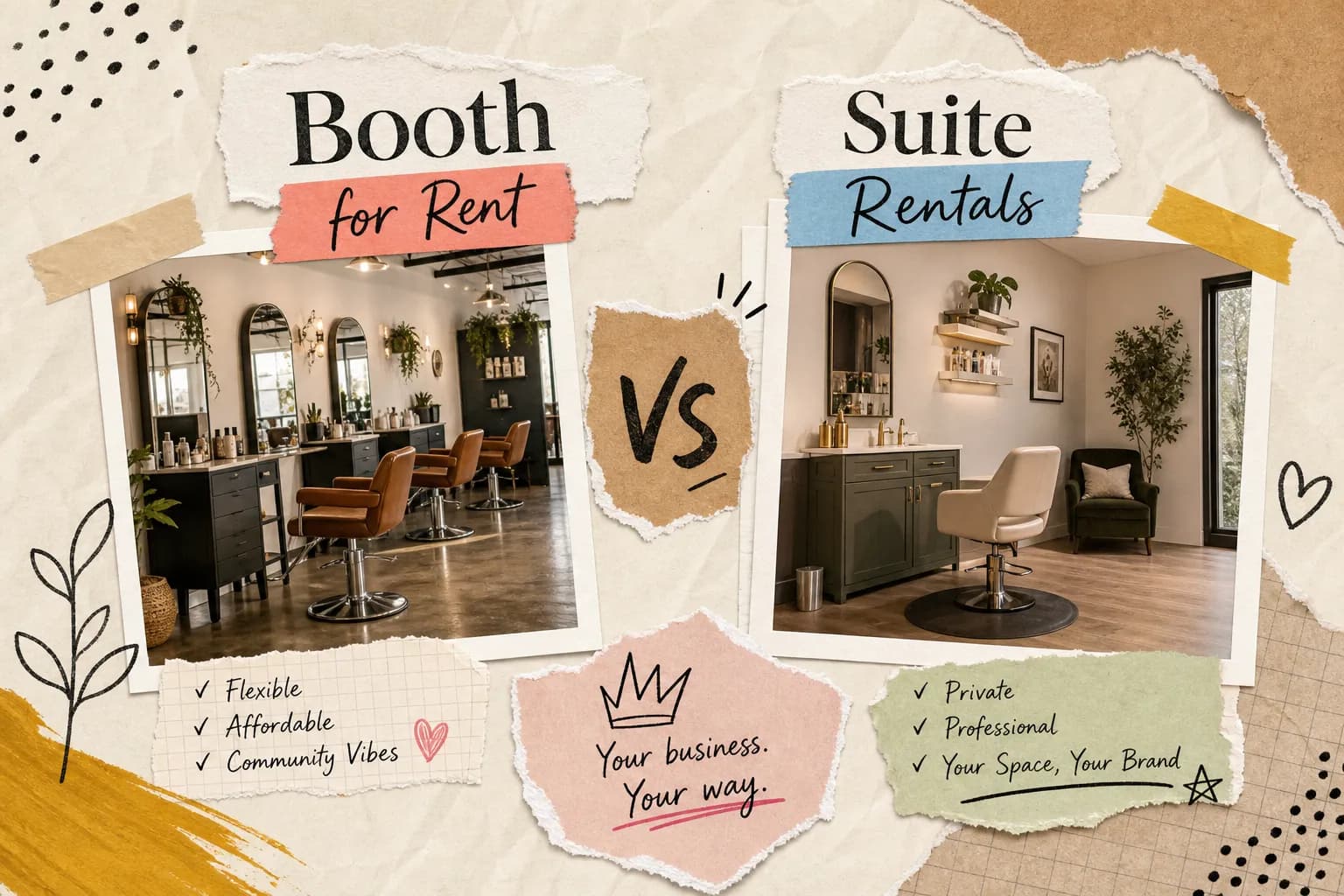
A salon booth for rent is a station on a shared salon floor. A suite rental is an enclosed, lockable room for one professional and one client at a time. In major U.S. cities, booth rents typically average $300 to $600 per week. In Metro Detroit, suite rent typically runs $650 to $1,800 per month, and you keep 100% of your service revenue with no commission split.
When you're ready to stop working for someone else, searching for salon booths for rent feels like the obvious first move. You want control. You want to set your own schedule, keep more of what you earn, and build something that's actually yours. A booth rental promises all of that. And for a lot of stylists, it largely delivers. However, some stylists want and demand more.
Here's what many beauty professionals discover after signing: booth rental and real independence are not always the same thing. You're still inside someone else's salon, working under someone else's rules, sharing a floor with people you didn't choose. The autonomy is real, but it has a ceiling. That ceiling is exactly why private salon suite concepts exist, and why the comparison between these two models is worth understanding before you commit to either.
This article focuses on the money: what each option includes, what it really costs, and the income math that decides which one pays off. For the full side-by-side of commission, booth rental and suites, including freedom, branding and the contract checklist, see our complete booth rental or salon suite guide.
Salon Booths for Rent: What's Actually Included
A traditional booth rental, also called chair rental or rent-a-chair depending on the market, is a designated station inside an open-floor salon. You pay a flat weekly or monthly rate to use that station and operate as an independent contractor rather than an employee. The host salon typically provides the chair, mirror, basic station setup, access to shared shampoo bowls, utilities, and sometimes Wi-Fi. Some agreements include towel laundry service or backbar product access. Most don't.
The shared-floor setup: what you get and who you share it with
On an open salon floor, multiple stylists work simultaneously, often just a few feet apart. Conversations bleed together. Dryers run in the background. The waiting area is shared. So is the backbar, the break room, and the general energy of the space. The terms "chair rental" and "booth rental" are used interchangeably in most markets, though a booth sometimes refers to a slightly more defined station with a bit more physical separation. Either way, you are not working in a private environment.
This setup works for a lot of stylists. The walk-in traffic, the built-in community, and the lower barrier to entry are real advantages, especially when you're building a clientele. But the shared floor also means shared noise, shared decision-making on policies, and a client experience that reflects the whole salon, not just your work.
What the weekly rate doesn't cover
The advertised booth rate is only part of what you'll actually spend. Professional liability insurance, color and product inventory, retail supplies, booking software, and payment processing fees all fall outside the rent itself. In major U.S. cities, booth rents typically average $300 to $600 per week, or roughly $1,300 to $2,600 per month. In Michigan and Midwest markets, rates generally sit at the lower end of that range. Professional liability insurance alone can run $200 to $300 annually, and once you factor in product inventory and processing fees, the real monthly cost is consistently higher than the number posted in the listing.
Budget for the complete picture before comparing options. A salon booth for rent at $250 a week sounds manageable until you calculate everything that sits on top of it.
Salon Suites: A Step Up from the Open Floor
A private salon suite is a fundamentally different setup. Instead of a station on a shared floor, you're renting an enclosed, lockable room that functions as its own small salon. One professional, one space, one client at a time. The experience, for both you and your clients, changes completely. It's Your Space. Your Rules.
Private, lockable, and fully yours during working hours
When you walk into a private suite, there's no background noise from neighboring stations, no shared waiting area conversations, no salon politics. The space is yours to decorate, brand, and operate as your business. You choose the music, the products, the décor, and the hours. Suite renters are still independent contractors, but the environment actually reflects that. A booth rental tells clients you work independently. A private suite shows them.
What a suite typically comes with compared to a booth
Quality suite operators include a private styling chair, mirror, cabinetry, a private sink or shampoo bowl, utilities, Wi-Fi, 24/7 building access, and a secure lock. That last detail matters more than it sounds. When the building is accessible around the clock and the suite locks behind you, your schedule becomes genuinely your own. Confirm the complete list before signing, operators vary more than the marketing suggests. The gap between a well-run suite operation and a basic room rental can be significant.
The Money Side: Pricing, Revenue, and What You Actually Keep
The financial comparison between booth rental and private suite rental is more nuanced than it first appears. The argument for suites isn't that they're cheaper. They usually aren't. The argument is that they create the conditions for you to earn more.
Salon booths for rent: what they cost in 2026
Across major U.S. markets, booth rents average $300 to $600 weekly, or $1,300 to $2,600 monthly. Premium or high-traffic locations push past $800 per week. In Metro Detroit and Southeast Michigan, rates are generally on the lower end of that range. The real monthly cost grows once insurance, product inventory, and fees are included, but a salon booth for rent remains the lower-cost entry point on paper.
Suite pricing and the income math that changes things
In Metro Detroit, suite rent typically runs $650 to $1,800 per month. Many suites inside that range land around $1,000 to $1,250 a month. Some premium rooms cost more. That's often higher than a comparable booth rate. But the income math looks different when you account for what you keep. In a private suite, you set your own prices, keep 100% of your service revenue with no commission split, and work in an environment that supports premium pricing. A stylist who raises service prices by even $10 per appointment and books two additional clients per week because of an improved client experience can cover a higher rent and still take home more than they did on the open floor.
Stylists who transition to private suites with a solid, established book often report earning $7,000 to $20,000 more annually, roughly $600 to $1,700 more per month. The critical variable is how full your schedule is. If you're fully booked, a salon suite makes the most sense. Our booth rent vs. suite calculator shows the difference for your own weekly rent. A strong book makes the numbers work clearly. A thin one makes the fixed rent feel heavier. Know where you stand before you sign. Many salon suite providers, including Cosmo Salon Studios, offer free introductory rent to help get you started. Cosmo Salon Studios has an industry leading 60 day Cosmo Guarantee.
Beyond the Money
Rent is only part of the decision. Control over your prices, products, hours and brand, and how private the client experience feels, all affect what you can charge and how often clients rebook. We cover those trade-offs in the booth rental or salon suite guide, and what working from a rented chair is like day to day in how chair rental works.
Contract Terms That Change the Real Cost
The advertised rate and the real cost can differ because of what's in the agreement. Before you compare numbers, request a complete written fee schedule, not just the advertised weekly rate. On a booth agreement, look for walk-in referral fees, product or retail restrictions, and whether rent continues during illness or vacation. On a suite lease, check which amenities are included, rent-increase terms at renewal, and the notice required to exit. For the full checklist, including client-list ownership and non-compete clauses, see booth rental contracts vs suite leases.
Making the Move to a Suite: What Michigan Beauty Professionals Are Choosing
Across Metro Detroit and Southeast Michigan, more licensed beauty professionals are choosing private suites over traditional booth rentals and salon space for lease arrangements. Once the comparison is clear, the shift makes sense. The environment supports higher pricing, the revenue model supports long-term income growth, and the experience supports the kind of client relationships that build a lasting business.
Why Cosmo Salon Studios stands out in Metro Detroit
Cosmo Salon Studios was built specifically for independent beauty professionals who are ready to stop giving a percentage of their earnings to someone else's business. With eight locations across Southeast Michigan, including Birmingham, Troy, West Bloomfield, Canton, Clarkston, Dearborn, Taylor, and Ann Arbor, and a ninth location opening in Macomb in 2027, Cosmo offers a turnkey private suite setup that includes a styling chair, mirror, cabinetry, utilities, and Wi-Fi. Renters keep 100% of their revenue, work a schedule they control, and operate with 24/7 building access in a fully equipped, lockable space. The community culture means you're in business for yourself, but not by yourself.
How to know if a suite is the right next step
If you're currently giving up 40% to 60% of your earnings, working inside a brand that isn't yours, or simply ready for a space that reflects the business you've actually built, a private suite is worth a serious look. Cosmo Salon Studios is currently offering move-in promotions including four weeks free and suite buildout credits, which makes now a practical time to explore the option rather than putting it off. Reach out to the Cosmo team directly to schedule a tour at a location near you.
The Real Question Behind This Comparison
The difference between salon booths for rent and private suites isn't just a question of square footage or weekly rates. It's a question about what kind of professional you want to be and what kind of experience your clients deserve. Both models have their place. A booth rental is a legitimate path, especially for stylists still building their book or looking for a lower-risk start.
But for beauty professionals who are ready to stop splitting revenue, stop operating inside someone else's brand, and start building something entirely their own, the private suite model is worth taking seriously. The client experience and the less-quantifiable satisfaction of walking into a space that is genuinely yours, on your schedule, with your name on the door, both support it in ways a spreadsheet can't fully capture. The income math gets you there first.
If you're searching for salon booths for rent near you or weighing a move to a private suite, get in touch with the Cosmo Salon Studios team and take a tour. No pressure, just a clear look at what's possible.
Frequently asked questions
What costs come on top of booth rent?
Professional liability insurance (often $200 to $300 a year), color and product inventory, retail supplies, booking software and payment processing fees. Once those are added, the real monthly cost is consistently higher than the advertised booth rate.
How much do salon booths for rent cost?
In major U.S. cities, booth rents typically average $300 to $600 per week, or roughly $1,300 to $2,600 per month. In Michigan and other Midwest markets, rates generally sit at the lower end of that range. Premium or high-traffic locations can push past $800 per week.
How much does a salon suite cost in Metro Detroit?
In Metro Detroit, suite rent typically runs $650 to $1,800 per month. That is often higher than a comparable booth rate.
Do you keep more of your revenue in a suite than in a booth?
Suites usually are not cheaper. In a private suite you set your own prices and keep 100% of your service revenue with no commission split. The case for a suite is the income it can support, not a lower rent.
What should I review before signing a booth agreement or a suite lease?
Request a complete written fee schedule, not just the advertised weekly rate, and confirm who keeps the client list if you leave. For a suite lease, confirm included amenities, your status as an independent operator, the notice required to exit, rent-increase terms, and after-hours access.
For Independent Beauty Professionals
Ready for a studio of your own?
Explore private salon suites across Southeast Michigan and find the Cosmo location that fits your business.