Salon suites explained: how they work and what they cost
How salon suites work, what they cost in 2026, and how they compare to booth rental and storefronts — plus what to ask before you sign a lease.
Published by Cosmo Salon Studios
September 11, 2026
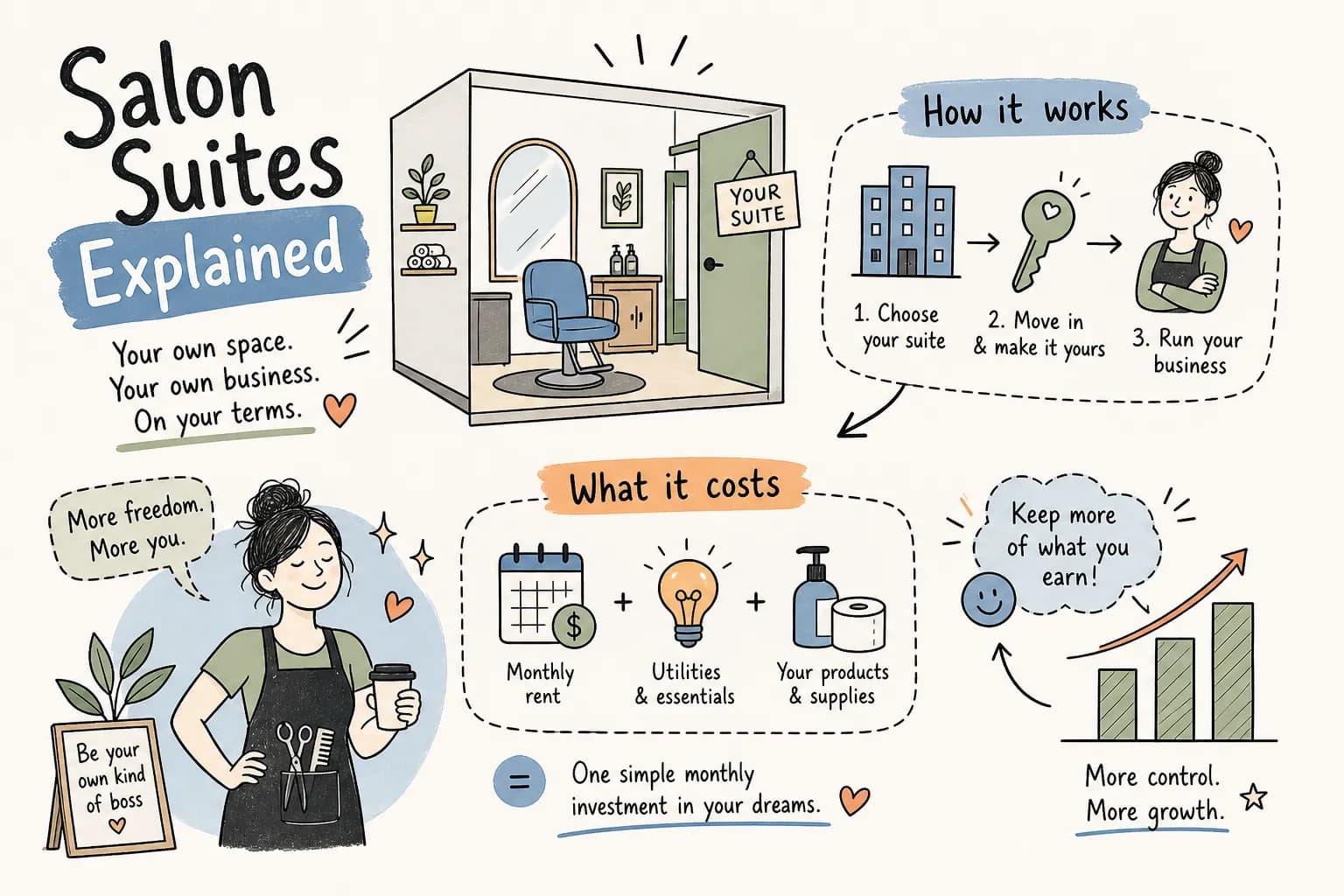
Salon suite explained: most licensed beauty professionals spend years building a loyal clientele, developing real relationships, and showing up day after day, only to hand a large share of every dollar they earn to someone else. Commission splits can take a significant portion of service revenue in traditional salon arrangements, and that reality is why so many stylists, estheticians, and nail technicians eventually start looking for another way to work.
A salon suite is that other way. In plain terms, it's a private, lockable studio inside a larger facility, leased by a beauty professional who keeps everything they earn. Often no commission splits. No shared floor. No one else's rules about your pricing or your clients. Places like Cosmo Salon Studios in Metro Detroit have built their entire model around this idea: private suites with 24/7 access, utilities included, and full freedom to make the space your own across nine salon suite locations in Southeast Michigan.
What follows is a straightforward look at how the salon suite model actually works, what it costs to get started, how it compares to booth rental and storefront leasing, and how to know whether it's the right move for where you are right now in your career.
Salon suite explained: the basics
A salon suite is a private, enclosed studio with its own four walls and a door. It sits inside a larger building that houses multiple similar spaces, all leased to different beauty professionals. Think of it less like a booth at a hair salon and more like a mini-salon that happens to share a building with other mini-salons, a private salon studio that you run entirely on your own terms. For a fuller definition, see what a salon suite is.
The physical setup
Inside a suite, you'll typically find a styling chair, a mirror, countertop space, and storage. Many include a shampoo bowl or utility sink. The renter has a key or keypad code, a door that closes behind them, and a space that is entirely theirs during business hours and beyond. At Cosmo Salon Studios specifically, suites come fully equipped, styling chair, mirror, countertop, storage, and utilities already included, so the day you sign a lease is essentially the day you can open your doors.
How a private suite differs from a commission floor
On a commission salon floor, the stylist works in a shared open space, with the salon owner controlling pricing, schedules, branding, and often product choices. A salon suite flips that structure entirely. The renter is the business owner. Their name is on the door, their prices are their own, and their relationship with every client belongs to them, not to the person who owns the building. It's a structural difference that changes everything about how you experience your work.
What's typically included in a suite rental
Many suite operators include furniture, utilities (electricity, water, Wi-Fi), common area maintenance, and building security in the monthly rent. Shared amenities like a laundry area, waiting room, or break room are common as well. That said, inclusions vary by operator and lease. Some bundle more, some less. Understanding exactly what's included before signing anything is one of the most important steps you can take, and the final section of this article gives you the specific questions to ask.
How the salon suite business model works
The mechanics are straightforward, but the implications run deep. Rent replaces commission. Independence replaces employment. The professional renting the suite takes on both the upside and the full responsibility of running their own business.
Rent replaces commission: the core trade
In a traditional commission salon, the stylist pays the house a percentage of every service performed. In a salon suite, the stylist pays a flat rent regardless of what they earn in a given week. A busy week means the renter keeps significantly more. A slow week still means rent is due. This is the fundamental trade the model asks every renter to make, and it's worth sitting with before signing anything.
Who controls pricing, scheduling, and clients
In practice, independence means the renter sets their own service prices, manages their own booking, chooses their own products, and owns every client relationship. There is no floor manager to check with and no salon owner whose approval you need. For professionals who are ready for that level of ownership, it's genuinely transformative. For those who aren't quite there yet, it can feel isolating without the right support structure. Cosmo Salon Studios addresses this by offering tenant support resources alongside the physical space, so independent stylists aren't figuring everything out entirely on their own.
The costs the renter now owns
Because the salon suite renter is running their own business, they absorb expenses a commission employer once covered: product inventory, marketing, booking software, business insurance, and self-employment taxes. These aren't hidden costs. They're the real price of independence, and they're why understanding the full cost picture before signing a lease matters more than most first-time renters expect.
What it realistically costs to rent a salon suite
Rent ranges vary widely by market, and the monthly figure is only part of the picture. Here's what to realistically budget for before you sign.
Monthly rent ranges across U.S. markets in 2026
Typical monthly rent for a salon suite in 2026 runs roughly $800 to $2,500 in most mid-size to large metros. Smaller markets often fall closer to $600 to $1,000, and major coastal cities can reach $1,800 to $3,000 or more. In Metro Detroit, suite rent typically runs $650 to $1,800 per month. Some premium rooms cost more, up to about $2,100 a month. Note that many leases are quoted weekly, so always convert to a monthly figure for an accurate comparison before you start weighing your options.
Startup and move-in costs to budget for
For a single suite, most beauty professionals should plan for $5,000 to $15,000 in total startup costs. This typically covers the lease deposit, first month's rent, any equipment not already included in the suite, initial product inventory, branding and signage, and business insurance. Some suite operators run move-in promotions that can meaningfully reduce that upfront burden. Cosmo Salon Studios, for example, has offered incentives including complimentary weeks of rent and buildout credits for qualifying renters, the kind of support that changes the math considerably for someone making the jump from a commission salon. Confirm current promotions directly with the leasing team, as offerings vary by location and availability.
Operating costs beyond the rent line
Once you're in the suite, ongoing costs include product restocking, marketing, booking and payment software, and professional liability insurance. As an illustrative estimate, these line items, insurance, software subscriptions, and product inventory combined, can add several hundred dollars per month on top of rent for many suite renters. Understanding your true monthly number, rent plus operating costs combined, is what separates a realistic business plan from a wishful one. The professionals who thrive in suites are the ones who run the numbers honestly before they move in, not after. A quick way to start is our salon suite calculator.
Salon suite vs. booth rental vs. storefront salon
Each model works. The question is which one fits where you are right now.
Booth rental: less commitment, less control
Booth rental sits between commission employment and a full suite. You rent a station, not a private room, inside someone else's salon. Booth rental rates are commonly quoted weekly, roughly $150 to $400 per week in many markets, which translates to approximately $600 to $1,600 per month depending on the market and what's included. The setup is leaner, but the trade-off is real: you're still sharing the salon floor, operating under someone else's environment, and working with limited ability to customize or brand your space. For someone just testing independence for the first time, booth rental can be a reasonable starting point. For an independent stylist with an established book who wants to charge premium rates, it's a ceiling. For a closer comparison, see chair rental vs. salon suite.
Why a private suite costs more but offers more
A salon suite costs more per month than most booth rentals, but it delivers something a shared floor cannot: a fully private, brandable, lockable space where every detail of the client experience is in your hands. For professionals who want to charge premium prices and create a premium experience, a private beauty suite makes that positioning credible in a way a shared floor never will. The space itself becomes part of the brand, and that's not a small thing.
When a storefront lease makes sense instead
A storefront salon lease is the highest-cost, highest-complexity option. It makes the most sense for professionals who want to build a multi-stylist team, invest in walk-in traffic, and grow a recognizable branded salon business. It requires the most capital, the most management, and the most operational systems. For solo practitioners or those testing independent ownership for the first time, a salon suite is often a smarter starting point, lower overhead, less complexity, and room to scale up once the business is established. Starting with too much overhead is harder to recover from.
Who benefits most from renting a private suite
When you look at who actually thrives in a salon studio rental arrangement, three clear profiles emerge.
The commission stylist ready to stop splitting revenue
This is the most common suite renter: a licensed stylist, colorist, or esthetician with an existing book of clients who is tired of giving the house a large cut of every service. If you already have clients who follow you and you've been working in the industry for at least two or three years, the math often works in your favor inside a suite. At that point, the flat rent can cost less per month than what commission splits were taking, making the move worth a serious look. If you're already leaning that way, how to leave a commission salon covers the practical exit.
Specialty providers who need a private space
Lash artists, brow technicians, permanent makeup artists, and massage therapists don't work well in an open salon environment. Their services require privacy, quiet, and focused one-on-one attention. A private studio gives them what a commission floor or shared booth simply cannot: a professional, controlled room they fully own. For this group, the suite model isn't just a business preference, it's a functional requirement the open floor will never satisfy.
Established professionals who want less overhead, more focus
Some suite renters are former salon owners who built a team, grew a payroll, and eventually realized the business they'd built was consuming them. A private suite lets them return to what they do best: serving clients directly, without managing staff, handling HR, or carrying high fixed overhead. Simpler isn't lesser. For this group, a well-equipped suite is a deliberate step forward, not a step back.
Key questions to ask before signing a salon suite lease
The right suite depends on more than the monthly rent. These are the questions that matter before you commit.
Lease length, renewal terms, and exit conditions
Most salon suite leases run six or twelve months with automatic renewal unless written notice is given 30 to 60 days before the end of the term. Ask for the exact renewal and exit language upfront. Find out what happens if your situation changes mid-lease: whether there's a sublet provision, an early termination clause, or a buyout option. These aren't hypotheticals, they're real scenarios that catch unprepared renters off guard, and the lease language controls, not what anyone told you verbally.
What's actually included and what costs extra
Get the full list of included items in writing: utilities, common area maintenance, parking, shared amenities, and any equipment already in the suite. Then ask explicitly what's not included. Some operators bundle everything cleanly into one monthly figure. Others list a lower base rent but charge separately for utilities, product fees, or shared services. The headline rent number rarely tells the whole story, and the difference between an all-in lease and a base-plus lease can be significant over the course of a year.
Access hours, customization rules, and operating policies
Ask about building access hours. Around-the-clock access is often a differentiator for professionals who keep non-traditional schedules or want early morning and late evening availability. Ask what customization is permitted: can you paint the walls, hang your own décor, bring in furniture? Ask about signage, client parking, shared space rules, and what maintenance responsibilities fall on you versus the operator. A well-run facility answers these questions clearly before you sign. If they can't or won't, that's a signal worth paying attention to.
The model works when you're ready for it
A salon suite is not just a real estate arrangement. It's the infrastructure of an independent beauty business. The model works when the professional renting the suite is ready to run their own operation, pricing, marketing, client relationships, and all of it. It works less well when someone wants the freedom of ownership without the responsibility that comes with it.
For beauty professionals in Metro Detroit and Southeast Michigan who are ready to make that move, Cosmo Salon Studios operates nine locations built specifically for this transition, fully equipped, fully private, and designed to support independent professionals from day one. The community and support structure are there. The turnkey setup is there. What's left is the decision.
If you're weighing whether a salon suite is the right next step, the clearest way to find out is to see one in person. Getting the salon suite explained on a tour, with your specific questions in hand, is far more useful than reading any checklist. Contact the team at Cosmo Salon Studios to schedule a visit at a location near you.
For Independent Beauty Professionals
See a salon suite in person
Tour a Cosmo location near you and get your specific questions answered before you sign anything.