How Licensed Cosmetologists Can Start Their Own Salon
How licensed cosmetologists can start their own salon: establishment licenses, LLC vs sole prop, startup costs, salon suite rental, pricing, first clients, and a 90-day checklist.
Published by Cosmo Salon Studios
September 14, 2026
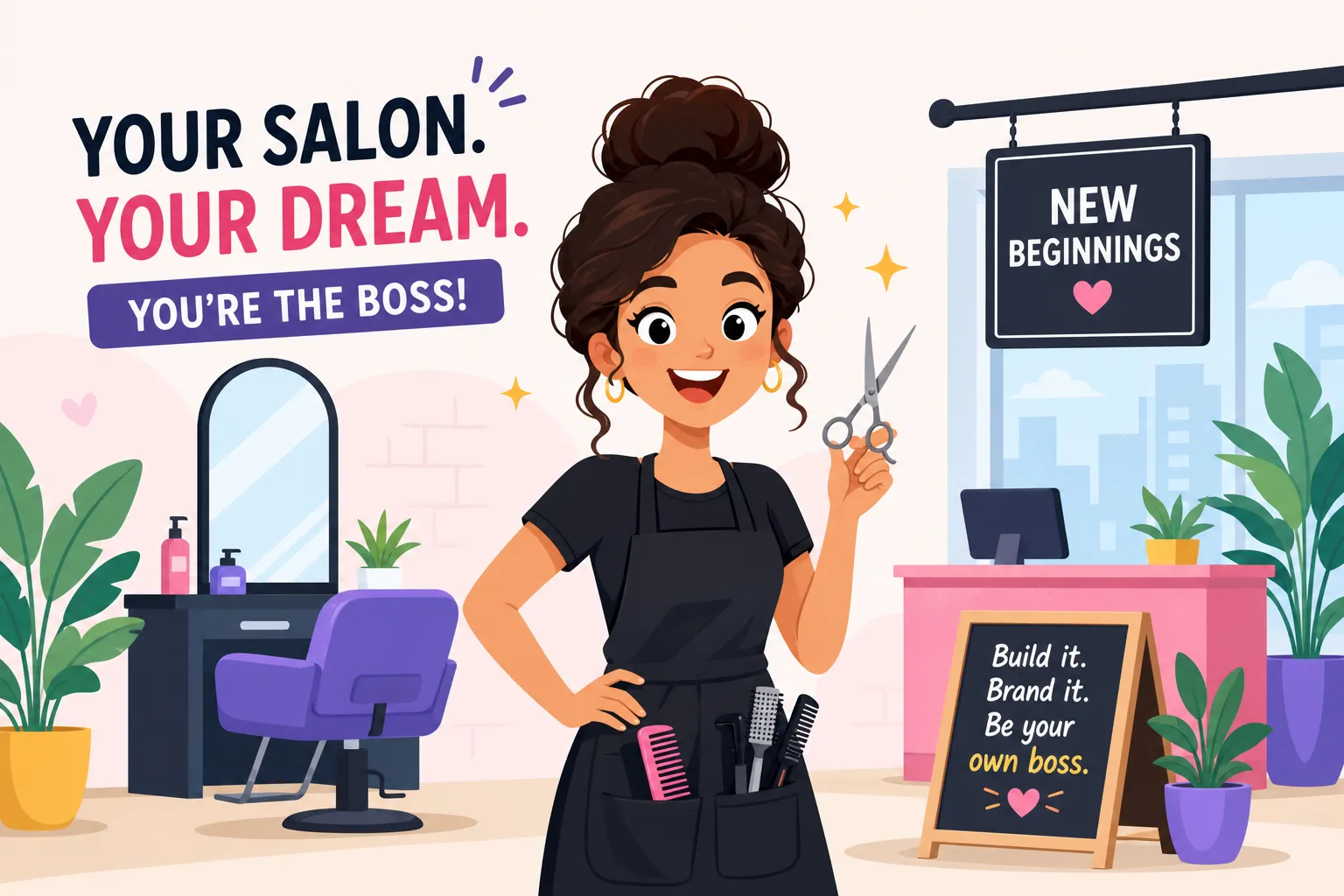
Passing your boards doesn't make you a business owner. That part takes a few deliberate decisions most cosmetology schools never cover. And without those decisions made in the right order, many newly licensed cosmetologists end up doing one of two things: stalling for months until they feel "ready," or rushing into a costly buildout they can't sustain past the first year. Neither path is wrong out of ignorance. They're just unnecessary.
There's a middle road, and it's one that a growing number of independent beauty professionals in Metro Detroit are taking right now. Get your establishment license in place. Choose a legal structure that protects you. Price your services honestly from day one. Find your first clients through the people who already trust you. Then pick a workspace that lets you grow without betting your savings on a five-year commercial lease. That last decision, the workspace one, is often the moment everything else clicks into place. We'll get to it.
If you're figuring out how to start a salon business as a licensed cosmetologist, the steps below will walk you through every decision, in the order it actually matters.
What licenses and permits you actually need before opening
Your individual cosmetology license, the one you just earned through your state board, is a personal credential. It follows you, not a location. It proves you're qualified to perform services. What it doesn't do is authorize you to operate a salon.
The salon establishment license is a separate requirement
In every major state, including California, Florida, New York, Texas, and Michigan, you need a separate state-issued salon or establishment license before you open a location for business. In Michigan, this is a Cosmetology Establishment License issued through the state's MiPLUS system. The application fee is $75 for a two-year license. You'll submit a floor plan showing equipment placement, pay the fee online, and then wait for a state inspection before the license is issued. Michigan's average processing time runs four to six weeks, so apply before you're ready to open, not the week of.
Local permits most new owners miss
Beyond the state establishment license, most cities and counties require a local business license or tax certificate, zoning approval confirming the space is permitted for salon use, and a certificate of occupancy if the location hasn't previously operated as a salon. If you're doing any buildout work, plumbing, electrical, or wall changes, you'll need building permits on top of that. The administrative steps are straightforward for most jurisdictions, but they are time-consuming and vary by location. Work through them in sequence and consult your local building or zoning department if you're unsure where to start. Everything needs to be in place before clients walk through the door.
How to start a salon business as a licensed cosmetologist: choosing your legal structure
If you start taking clients without forming a business entity, you are legally a sole proprietor. That's not a criticism, it's the default, and it works fine early on. You report income and expenses on Schedule C, pay self-employment tax on your net earnings (15.3% on 92.35% of net profit), and carry almost no administrative overhead.
When forming an LLC makes sense
The practical case for forming a single-member LLC early is about liability separation, not taxes. As a sole proprietor, your personal assets are exposed to business liability. That matters the moment you're renting a space and working with chemicals. An LLC creates a legal wall between your business debts and your personal finances. In Michigan, forming one is a straightforward state filing, and you'll pair it with an EIN from the IRS to open a dedicated business bank account. From a tax standpoint, the IRS treats a default single-member LLC exactly like a sole proprietorship: same Schedule C, same self-employment tax. The structure changes the protection, not the tax math.
A note on S-corp treatment
You'll hear about S-corp elections eventually. An S-corp is a tax election, not a separate structure, and it can reduce self-employment taxes at higher income levels by splitting income between salary and distributions. It also adds payroll complexity and compliance requirements that most new salon owners don't need in year one, including the need to document "reasonable compensation." File it away for later, once your revenue justifies the additional administration.
What salon startup actually costs (and a smarter path forward)
The honest numbers for opening a traditional full-service salon break down like this. Buildout typically runs $20,000 to $80,000. Equipment and furniture add another $8,000 to $40,000. Licensing and permits fall between $500 and $5,000. Working capital for your first few months of operating costs can run $15,000 to $50,000. A basic marketing launch adds $2,000 to $15,000. The realistic total before you take your first client lands somewhere between $75,000 and $150,000. That's not meant to be discouraging, it's the math of a traditional buildout, and it's useful to see it clearly.
Financing options for salon startups
SBA microloans, capped at $50,000 and issued through community lenders, are among the most startup-friendly financing options for newly licensed cosmetologists. SBA Community Advantage lenders and local CDFI lenders typically accept applicants with credit scores around 580 or above, particularly when paired with a solid business plan, and many don't require prior operating history. SBA 7(a) loans go up to $5 million but generally require 650+ credit, two or more years of operating history, and strong documentation, which makes them harder to access at the start. Equipment financing is another option worth exploring, since the equipment itself serves as collateral.
Why salon suite rental changes the math completely
Here's where the numbers shift. A salon suite eliminates buildout costs entirely. You walk into a fully equipped, private space on day one. In Michigan, suite rental runs roughly $600 to $2,500 per month depending on market and suite size, with utilities and Wi-Fi often included. Many suite arrangements charge flat rent with no commission taken from your earnings, though lease terms vary by provider, so review your contract carefully for any additional fees before signing. To see what a suite would leave you with at your own prices, try our salon suite calculator.
Cosmo Salon Studios operates multiple salon suite locations across Metro Detroit and Southeast Michigan, with turnkey suites designed to be move-in ready. For a newly licensed cosmetologist figuring out how to start a salon business, that kind of low-barrier entry point can make the difference between launching this year and waiting indefinitely.
How to price your services from the start
Starting with low prices to "build a book" is common advice. It's also a pricing trap. Clients tend to anchor to the rate they paid first, a well-documented pattern in pricing psychology, and raising prices later often triggers pushback even when the increase is completely justified. Your license took real time and money to earn. Your overhead is real. Price accordingly from the beginning.
Here's a practical framework. Calculate your fixed monthly costs (suite rental, supplies, insurance). Determine how many clients you can realistically see in a week. Work backward to a minimum hourly rate that covers those costs with margin left over. Then check what independent stylists in Metro Detroit are actually charging. In 2026, women's cuts run roughly $45 to $90, single-process color from $60 to $120, and standard treatments from $25 to $85, with specialty treatments reaching $150 to $300. Your rate should sit within that market range while covering your costs. When you're consistently booked out two or more weeks in advance, raise your rates. That's your signal, not a calendar date.
How to find and keep your first clients
Your first 20 clients aren't strangers. They're people who already know you: family, friends, former classmates, coworkers, neighbors. Start there. Be direct about what you offer, where you're located, and how to book. Don't overthink the launch or wait until everything feels perfect. Personal outreach to people who already trust you will typically yield faster bookings in the first month than any paid ad campaign you could run.
After that initial wave, three channels do the heavy lifting for an independent cosmetologist without a marketing budget:
- A complete, accurate Google Business Profile with your services, location, and hours listed
- An Instagram or TikTok portfolio of real client work posted consistently
- A simple online booking link that makes it frictionless to schedule
These three, maintained consistently, generate organic discovery without ongoing ad spend. Once you have clients coming in, build a referral system immediately. A simple incentive for existing clients who send new bookings, a discount or a complimentary add-on, ranks among the most effective marketing channels in personal services, consistently outperforming paid acquisition for independent stylists. Word of mouth in a private suite feels more exclusive than a referral from an open salon floor, and clients notice that.
Your open a salon checklist: 90 days from licensed to open
Break the process into three phases. Each one has a clear finish line.
Days 1 to 30: get the legal and financial foundation in place
Form your LLC, apply for your EIN, and open a dedicated business bank account. Apply for your Michigan Cosmetology Establishment License through MiPLUS and submit your floor plan. Choose your workspace. A move-in-ready salon suite compresses your setup timeline significantly compared to a traditional buildout, which can take several months before a space is occupancy-ready. Use that time advantage.
Days 31 to 60: build your client-facing presence
Finalize your service menu and set your rates. Set up your booking system so clients can schedule without having to call you. Build out your Google Business Profile completely, including photos of your suite and service descriptions. Post your first portfolio content. These steps should be complete before you take your first paying client, not after.
Days 61 to 90: open, take feedback, and build momentum
Start booking clients. Ask for honest feedback. Watch your schedule for patterns, which services are filling fastest, which time slots are most requested, when you're turning people away. Adjust pricing if your costs aren't covered. Activate your referral system with your first satisfied clients. The goal at day 90 isn't a perfect business. It's a real one, with real clients and real revenue, that you can actually build from.
Starting small is not thinking small
Learning how to start a salon business as a licensed cosmetologist doesn't require a six-figure buildout or years of planning. It requires a few intentional decisions made in the right sequence. Get the legal foundation in place. Price your services to be sustainable. Show up where clients can find you. Choose a workspace that gives you a professional environment without demanding everything you have upfront.
For many newly licensed beauty professionals in Michigan, the workspace decision is the one that makes everything else possible. Cosmo Salon Studios offers fully equipped private suites across Metro Detroit and Southeast Michigan, a low-overhead starting point built around independent professionals who want to own their business without taking on the cost and risk of a traditional buildout. If you're ready to stop waiting and start building, schedule a tour at the Cosmo Salon Studios location nearest you.
Frequently asked questions
How do I start a salon business as a licensed cosmetologist?
The core steps are: secure your salon establishment license (separate from your personal cosmetology license), choose a business structure, set up a dedicated business bank account, select a workspace, finalize pricing, and build your client-facing presence before you open. Following these steps in order prevents the most common delays new owners face.
Do I need a separate license to open a salon after getting my cosmetology license?
Yes. Your individual cosmetology license authorizes you to perform services. A salon or establishment license, issued at the state level, is required to operate a salon location. In Michigan, this is the Cosmetology Establishment License, applied for through MiPLUS.
What does it cost to open a salon as a licensed cosmetologist?
A traditional buildout runs $75,000 to $150,000 in total startup costs. A salon suite model significantly reduces that number by eliminating buildout expenses, with monthly rent in Michigan typically ranging from $600 to $2,500.
What is a home hair salon setup, and is it a viable option?
A home hair salon setup means operating out of a dedicated space in your residence. It's a low-cost starting point, but it requires zoning approval from your municipality, a state establishment license for the space, and compliance with local health and safety codes. Check with your local zoning office before investing in equipment or taking clients at home.
How long does it take to open a salon after getting licensed?
With a move-in-ready salon suite, most of the legal and setup work can be completed within 30 to 60 days. A traditional buildout typically takes several months longer due to construction timelines and inspection requirements.
For Independent Beauty Professionals
Ready for a studio of your own?
Explore private salon suites across Southeast Michigan and find the Cosmo location that fits your business.