The complete salon startup checklist for beauty school grads
What you need to start your own salon business after beauty school: LLC vs sole prop, Michigan licenses, startup costs, equipment, insurance, and a 90-day checklist.
Published by Cosmo Salon Studios
September 10, 2026
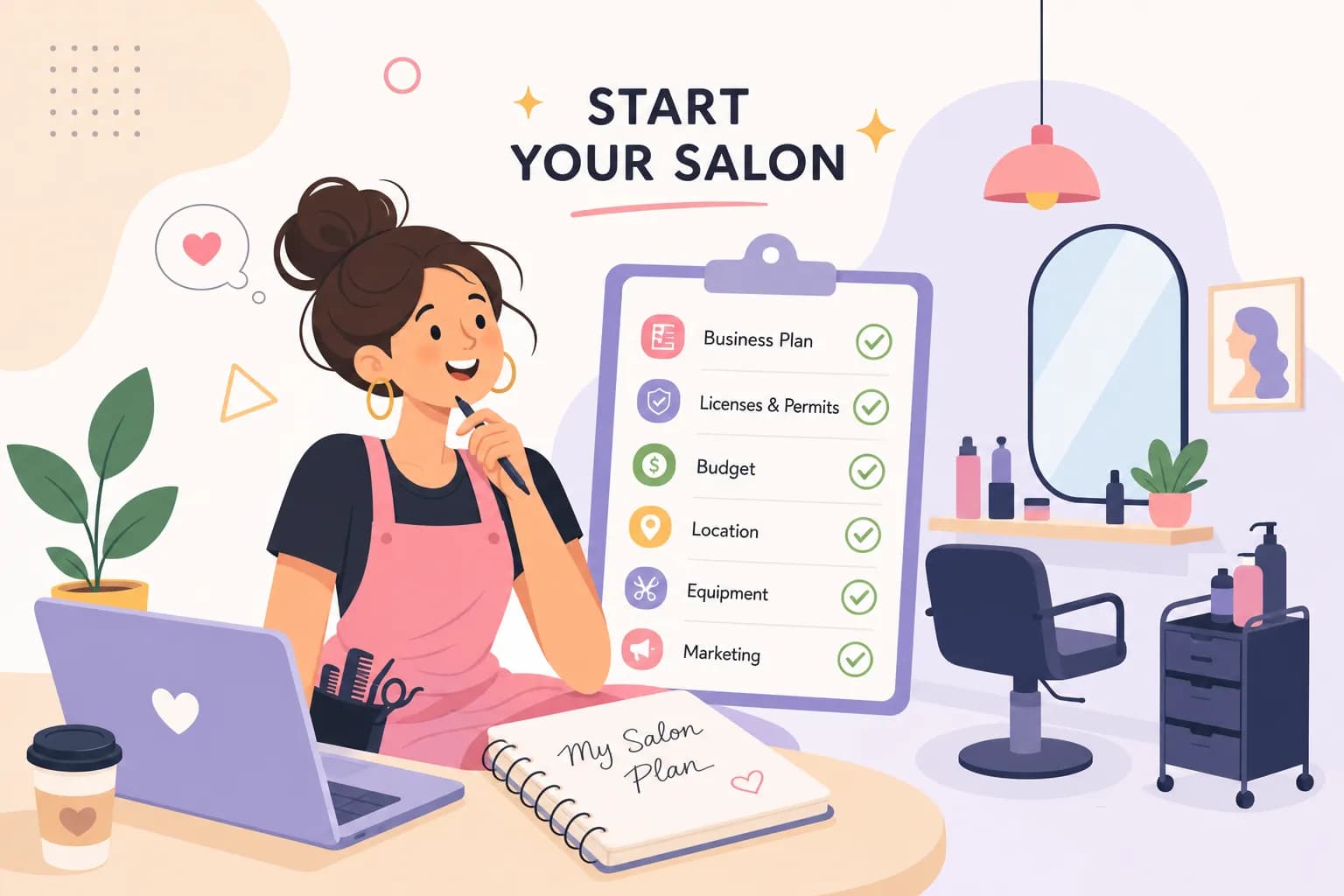
Graduation day gets all the attention. The diploma, the photos, the people who drove hours to watch you walk across a stage. And then Monday arrives, and nobody hands you a map.
If you've been trying to figure out what you need to start your own salon business after beauty school, the answer is: more than most people tell you, and less complicated than it looks. This checklist covers every practical step between finishing school and seeing your first independent client, business registration, state and local licenses, realistic startup costs, the equipment you actually need, and the insurance you can't skip. It also covers the option many Michigan beauty pros use to skip the most expensive step entirely.
Register your business before you do anything else
Before you pick a location, buy a single chair, or post anything on social media about your new salon, the business entity comes first. Operating without a proper structure means your personal finances and assets are directly exposed if something goes wrong.
LLC vs. sole proprietorship for a new salon owner
A sole proprietorship is free and simple: there's no state filing, and you can start immediately. The problem is that it doesn't separate your personal assets from your business liabilities. One client claim or lease dispute, and your savings are on the table. An LLC costs more upfront, but Michigan's filing fee is just $50 through LARA. For most new salon owners, especially those leasing space, selling retail, or eventually hiring anyone, an LLC is the smarter default from day one.
Filing Articles of Organization (Form CSCL/CD-700) online through LARA typically processes in about 7 to 10 business days. Expedited options are available: 24-hour processing runs $100, and same-day service runs $150.
EIN, business bank account, and sales tax permit
Once your LLC is formed, get your EIN from the IRS immediately. It's free, takes minutes online, and you'll need it to open a business bank account, handle taxes, and work with suppliers. Open that business bank account the same week so your personal and business finances never mix. If you plan to sell any retail products, register for a Michigan sales tax permit as well. These aren't optional formalities; they're the foundation that everything else is built on.
Salon licensing requirements: what you need to legally operate
Here's the distinction that catches a lot of new grads off guard: your cosmetology license, the one you earned in school, is your personal license to practice. It does not give you the legal right to operate a salon. You need both. Understanding salon licensing requirements before you sign a lease saves you from costly delays down the road.
Your state salon establishment license
Michigan requires a separate cosmetology establishment license issued by the state board for any physical salon location. The license is tied to the premises, not the individual. The current initial fee is $75, and the application is completed online through MiPLUS. You'll need to upload a drawing or diagram showing the layout of required equipment and facilities, and the space must pass a state inspection before the license is issued. Plan for this process to take several weeks.
Local permits: zoning, health department, and certificate of occupancy
Beyond the state board, there's a local layer. Zoning approval confirms your space is permitted for personal services use. A health department or sanitation permit is required in most jurisdictions because salons are subject to health and hygiene inspections. A certificate of occupancy confirms the commercial space is legally approved for use. If your buildout involves adding sinks, shampoo bowls, ventilation, or walls, expect building, plumbing, and electrical permits in addition. This is where the timeline stretches and the costs start to climb.
What it actually costs to start your own salon business after beauty school
This is where the checklist gets uncomfortable for most new grads. The numbers are real, and they're worth knowing clearly before you commit to a path.
Buildout, equipment, and working capital ranges
A small salon buildout typically runs between $15,000 and $75,000, depending on the space and how much renovation it needs. Plumbing alone for shampoo bowls can add $2,000 to $8,000 per bowl depending on existing infrastructure. Equipment adds another $10,000 to $40,000. Initial inventory runs roughly $2,000 to $8,000, and working capital to cover the first several months of operating expenses adds more on top of that. Total startup costs for a small salon land somewhere between $50,000 and $145,000. Most new graduates don't have that capital sitting in an account, and most lenders aren't eager to extend it to someone with no operating history.
How a turnkey salon suite changes the math entirely
This is the part of the checklist worth paying close attention to if those numbers gave you pause. Cosmo Salon Studios provides fully equipped private suites across nine locations in Metro Detroit and Southeast Michigan. The suite typically includes a styling chair, mirror, storage, countertop, utilities, and Wi-Fi. The $15,000 to $75,000 buildout line item disappears from your checklist, and what's left is a predictable monthly lease instead of a one-time capital outlay.
Cosmo's standard lease structure allows tenants to retain their service revenue, which means the math shifts quickly once you're operational. Rather than burning capital for months before your doors open, many tenants are able to begin seeing clients much sooner than a traditional buildout would allow. That's not a consolation prize; it's a practical business decision that a lot of experienced beauty pros are making on purpose. Contact Cosmo directly to ask about current move-in terms and any available incentives for new tenants. Before you call, you can estimate what you'd keep in a suite with your expected clients and prices.
Equipment and supplies you need before your first client
Regardless of whether you build your own space or lease a suite, there's a layer of equipment that belongs to you as the stylist, not the space. This is your professional toolkit, and it travels with your career.
Furniture, stations, and shampoo setup
For those building from scratch, the non-negotiables are a styling chair, mirror, station, shampoo bowl and backwash unit, storage cabinets, and a reception area. In a fully equipped suite like those at Cosmo Salon Studios, most of this is already in place. Your investment shifts to professional-grade personal tools rather than furniture and fixtures.
Tools, POS, and sanitation essentials
Your portable toolkit covers shears, combs, brushes, blow dryer, flat iron, capes and towels, spray bottles, and a full sanitation setup including disinfectants, Barbicide, gloves, and wipes. On the tech side, a booking and scheduling app is strongly recommended from day one. GlossGenius and Square Appointments are widely used options for independent solo stylists; both handle scheduling, payments, and client management without requiring much setup time. Add a mobile card reader and you're ready to take your first payment. These costs are yours regardless of whether you lease a suite or open your own space.
The insurance coverage you need from day one
Skipping insurance to save money in the first few months is the most expensive mistake a new salon owner can make. One chemical reaction, one slip-and-fall, one property claim, and an uninsured operator absorbs all of it personally.
General and professional liability: the core coverage
General liability covers third-party injury and property damage claims. Professional liability covers claims arising from a service gone wrong, such as a chemical burn or allergic reaction. Both are essential from your first day of business. Premiums for general liability typically run $300 to $800 per year; professional liability adds another $200 to $600. That's a manageable annual cost compared to the exposure of going without it.
Business owner's policy and when you need more
A business owner's policy, or BOP, bundles general liability with commercial property coverage into a single policy. For a solo salon operating in its own space, a BOP typically runs $1,500 to $3,000 per year for a small location. Suite renters work with a slightly different coverage mix since the building itself is covered by the landlord's policy; your focus is on your tools, equipment, and liability. If you hire anyone at any point, workers' compensation becomes mandatory in Michigan. Get that coverage in place before the first shift, not after.
Checklist: what you need to start your own salon business after beauty school
The order matters as much as the list itself. Here's a realistic sequence for your first 90 days:
- Week 1: Form your LLC and obtain your EIN from the IRS
- Week 1, 2: Open a dedicated business bank account and register for a Michigan sales tax permit if you plan to sell retail
- Once you have a confirmed location: Apply for your Michigan cosmetology establishment license through MiPLUS and file for local zoning, health department, and occupancy permits
- Before your first client: Secure general liability and professional liability insurance, do not skip this step
- Ongoing: Build your equipment list around your specific services and price range, prioritizing tools over furniture if you're leasing a turnkey space
If the buildout costs in this article gave you pause, that reaction is worth sitting with. Cosmo Salon Studios exists precisely for beauty professionals who want to skip the construction phase, the permitting process, and the capital risk, and get straight to the work they trained for. With nine locations across Metro Detroit and Southeast Michigan, including Birmingham, Troy, West Bloomfield, Canton, Clarkston, Dearborn, Taylor, and Ann Arbor, the suites are move-in ready and the path from beauty school graduate to independent business owner is shorter than most people expect. Reach out to the Cosmo team directly to schedule a tour of the location closest to you.
Figuring out what you need to start your own salon business after beauty school takes real effort, but none of it is impossible. You've already done the hardest part.
For Independent Beauty Professionals
Skip the construction phase
Tour a move-in-ready Cosmo suite across Metro Detroit and Southeast Michigan and see the shorter path from beauty school graduate to independent business owner.