The Complete Launch Checklist for Independent Beauty Pros
A practical launch checklist for independent beauty professionals: licenses, insurance, workspace, equipment, pricing, systems, and a 90-day marketing plan.
Published by Cosmo Salon Studios
September 15, 2026
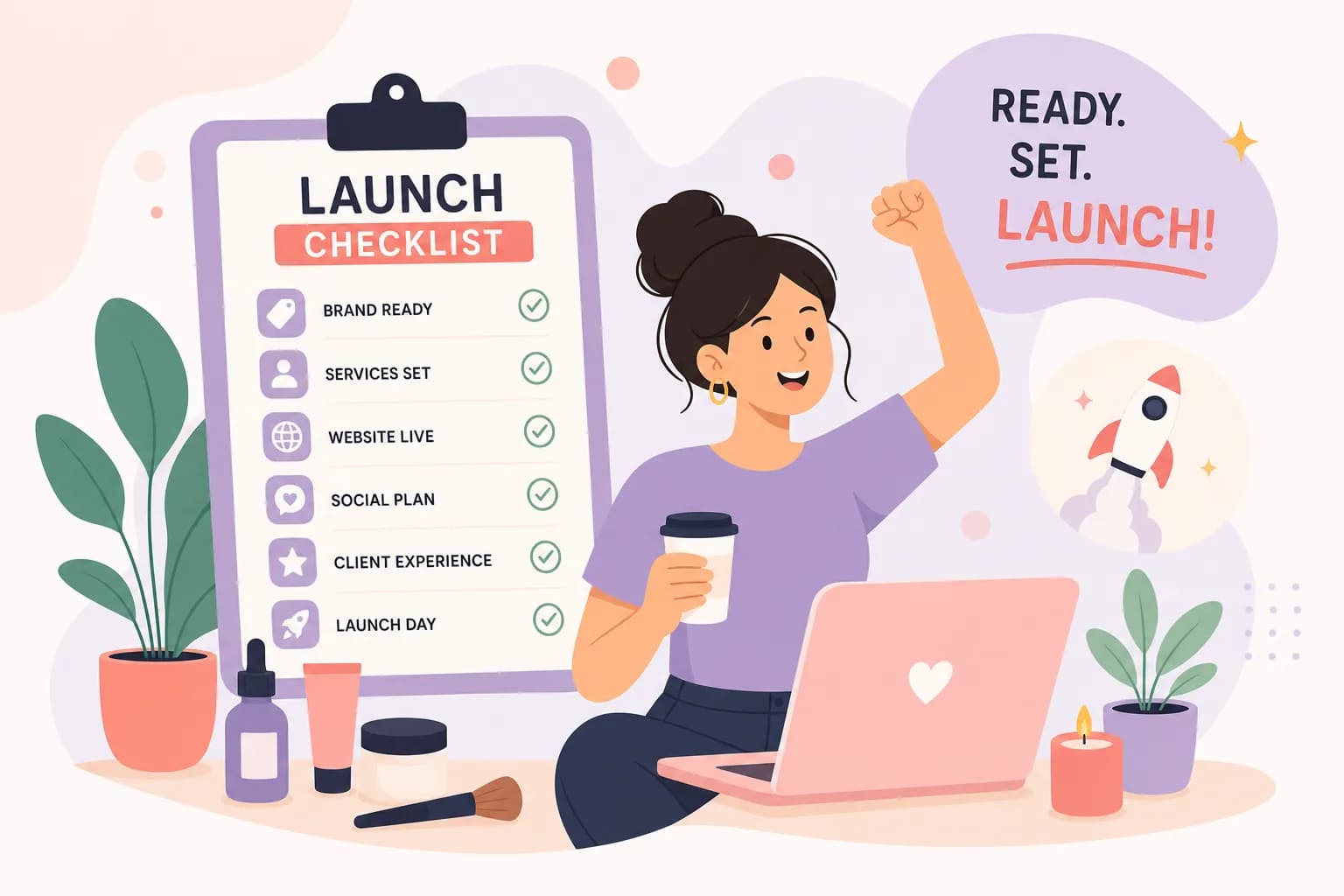
Going independent is one of the best decisions a beauty professional can make, and one of the most disorienting. There are a dozen things pulling for your attention at once, and without a clear sequence, it's easy to spend weeks spinning without actually moving forward.
The good news: this isn't complicated. It just needs order. What feels overwhelming is usually just a list of tasks that haven't been sorted yet. Work through them in the right sequence, and what looked like chaos starts to look like a plan.
This article walks through everything, from legal setup to your first booked client, as a practical checklist for launching an independent beauty business. One of the biggest decisions you'll make, choosing the right workspace, can simplify several other checklist items in a single move. Beauty professionals in Michigan who lease with Cosmo Salon Studios often skip months of setup logistics because the space, utilities, Wi-Fi, and support structure are already in place. Keep that in mind as you work through each section below.
Checklist for Launching an Independent Beauty Business: The Legal Foundation
What licenses you actually need before you open
Two layers of licensing apply in most states. The first is your individual professional credential, whether that's a cosmetologist license, esthetician license, nail technician license, or barber license. The second is a salon establishment or facility license issued by your state's cosmetology board, which covers the physical space where services are performed. Local business licenses and zoning approval from your city or county are also standard requirements.
Michigan follows this same two-layer pattern. Individual licensure requires completion of 1,500 training hours at a licensed cosmetology school (or a two-year apprenticeship), passage of both the practical and written exams through PSI Services, and being at least 17 years old with education equivalent to a ninth-grade level. For the establishment side, Michigan requires a Cosmetology Establishment License, applied for through MiPLUS (Michigan's online licensing portal) for a $75 two-year fee. The application requires a site diagram and a passed inspection before the license is issued. Each service category, esthetics, barbering, nail tech, has its own credential, so make sure you're applying for the right one.
Business registration and tax setup
Most solo beauty professionals launch as either a sole proprietor or a single-member LLC. The LLC adds a layer of liability protection and looks more professional on contracts, which many suite leases require. Either way, getting an EIN from the IRS is a smart move even without employees, because it lets you open a business bank account without putting your Social Security number on vendor applications.
If you plan to sell retail products, you'll also need a state sales tax permit. Separating your personal and business finances from day one, even with just a dedicated business checking account, makes tax season dramatically simpler and keeps your records clean if you ever get audited or apply for a business loan.
Insurance basics every independent beauty professional needs
Three types of coverage matter most for a solo beauty pro. General liability covers third-party injury and property damage claims, such as a client slipping in your suite. Professional liability covers treatment-related claims, such as a chemical burn or an allergic reaction from a service you performed. Property coverage protects your equipment and inventory.
A Business Owner's Policy (BOP) bundles general liability and property at a lower combined cost than buying them separately, making it the smartest starting point for solo operators. Ballpark annual premiums run approximately $425 to $810 for general liability, $600 to $1,200 for professional liability, and $1,400 to $1,687 for a BOP. Workers' comp is only required if you hire employees, so most solo suite renters can skip it at the start.
Workspace and Equipment: Two Checklist Items That Work Together
What to look for in a professional workspace
The three most common options for an independent beauty professional are booth rental, salon suite leasing, and building out a standalone location. Booth rental carries the lowest financial commitment but offers limited privacy, schedule control, and branding potential. A standalone build-out gives full ownership but can require substantial upfront capital, commonly ranging from $10,000 to well over $50,000 depending on scope and buildout requirements, plus months of construction time. A salon suite sits between those two extremes: private, professional, and a far lower barrier to entry.
A well-chosen suite should include a private lockable space, included utilities, reliable Wi-Fi, and access hours that fit your schedule, confirm specifics with each provider, since hours and amenities vary by lease. Monthly suite costs in Metro Detroit typically run $650 to $1,800 per month, depending on location and suite size, which compares favorably to the overhead burden of building or leasing a full salon space.
How Cosmo Salon Studios checks off multiple boxes at once
Cosmo Salon Studios is a specific example of a suite concept that collapses several items on your independent beauty business launch checklist into one lease decision. Each suite comes fully equipped with a styling chair, mirror, storage, countertop, utilities, and Wi-Fi already included. That means a launching beauty pro can cross off "find a workspace", "set up utilities", "get internet", and "source basic furniture" in a single tour.
With locations across Metro Detroit and Southeast Michigan, including Birmingham, Troy, West Bloomfield, Canton, Clarkston, Dearborn, Taylor, and Ann Arbor, there's likely a location close to your existing client base. Suites are fully customizable with paint and decor (see these salon suite decor ideas from real Cosmo suites), so you can build a branded environment from the moment you sign the lease. The model is built around a straightforward idea: go into business for yourself, but not by yourself.
Your equipment checklist by specialty
For hair stylists, your core equipment list includes a styling chair, station or rolling workstation, shampoo bowl, shears, clippers, dryer, flat iron, color supplies, capes, sanitation setup, and backbar products. For estheticians, think facial bed, steamer, magnifying lamp, hot towel cabinet, wax warmer, and core consumables like cotton rounds, cleansers, and masks.
A used or budget-friendly setup for either specialty typically runs $1,500 to $4,000. A new professional-grade setup runs $4,000 to $10,000 or more. One practical note: if your suite already includes furniture, your tool and supply list shrinks considerably, one of the less obvious financial advantages of leasing a turnkey suite.
Setting Your Prices and Getting Your Business Systems Running
How to price your services from day one
Start with your target hourly income. Decide what you need to earn per week to cover your suite rent, insurance, supplies, taxes, and personal expenses with room left over. Then back-calculate what your services need to cost based on the hours you can realistically book each week. Check that number against local market rates to confirm it's competitive. Our salon suite calculator shows how many clients a week it takes to cover suite rent at the prices you set.
The most common mistake new independent pros make is underpricing out of fear of losing clients. Going independent means keeping a significantly higher share of every dollar you earn compared to a commission arrangement, commission splits vary widely by salon and market, but independent ownership removes that split entirely. Your prices can and should reflect that shift. You're not competing with your old salon; you're offering a private, personalized experience that justifies premium pricing.
Booking software and payment tools to set up before launch
Get your booking and payment systems live before you announce your opening. That way, when the first wave of attention hits, clients can book immediately rather than waiting for a callback. Look for tools that handle online self-scheduling, card payments and tips, automatic appointment reminders, and a client-facing booking link you can drop into your Instagram bio or website. GlossGenius is a common choice among independent suite renters for its beauty-specific features, while Square Appointments works well as a free or low-cost entry point. Budget roughly $500 to $2,000 for a starter tech setup.
Basic accounting and money habits from day one
Open a business checking account before you take your first payment. Track income and expenses weekly, not at tax season. Set aside a fixed percentage of every payment for self-employment taxes, as an independent business owner, quarterly estimated taxes are now your responsibility. A painful April surprise is avoidable if you build the habit early. A simple spreadsheet or basic bookkeeping software is enough to start; you don't need a complicated system right away.
Your Pre-Launch Marketing Plan: 30, 60, and 90 Days Out
90 days out: build your foundation before you announce anything
In the 12 to 16 weeks before your launch, focus entirely on infrastructure. Finalize your business name and logo, create your social media profiles on Instagram and TikTok (two highly effective platforms for visual beauty content), and build a simple website or landing page with a waitlist sign-up. Shoot your first batch of portfolio content during this phase. This isn't about visibility yet; it's about building the systems that will carry your announcement when the time comes.
60 days out: start showing up and building anticipation
At the six to eight week mark, begin posting consistently. Share behind-the-scenes content of your suite setup, your specialty services, transformation content, and your personal story of going independent. Reach out to micro-influencers or potential ambassador clients who might share your opening in exchange for a complimentary service. Start building your email list by offering early-access booking to anyone who signs up, and begin researching local business partnerships with boutiques, wellness studios, or gyms near your location.
30 days out: ramp up and lock in first clients
Increase your posting frequency, send consistent emails to your waitlist, and run a soft pre-launch offer, for example, a discounted rate for a limited number of opening bookings (five to fifteen is a reasonable range depending on your capacity and margin). Activate your referral program with existing contacts who can spread the word. If budget allows, run targeted social ads in the final two weeks to expand your reach; a lean launch ad budget of $500 to $2,000 can meaningfully accelerate visibility. Aim to pre-book a meaningful portion of your opening-week schedule before launch day, many pros target 30 to 50% of available slots. On launch day, combine daily social posts with a launch-day email to drive the remaining bookings.
Putting It All Into a Workable Sequence
A practical order for checking everything off your independent beauty business launch checklist
The full checklist follows this priority order: licensing and registration first, insurance second, workspace decision third (since it directly affects your equipment list), pricing and systems fourth, and marketing fifth. This order isn't arbitrary. You can't market a workspace you haven't chosen. You can't book clients without set prices. And you can't legally serve anyone without the proper credentials in place. The checklist is a dependency chain, not just a list.
The mindset shift that makes launching feel manageable
Going independent doesn't mean having everything perfect before you open. It means being prepared enough to serve your first client well and learning the rest as you go. Many independent pros describe the same pattern once they're on the other side: the first client makes everything feel real, and the preparation they'd done gave them the confidence to show up fully. The checklist is a tool to get you there, not a finish line to cross.
One Step at a Time Gets You There
Using a solid checklist for launching an independent beauty business is the clearest way to move from overwhelmed to ready. Each item you complete removes a layer of uncertainty from the decisions that follow. Work through the list in order, and the launch that felt impossible at the start becomes something you can actually execute.
For beauty professionals in Michigan looking to simplify the workspace side of this checklist, Cosmo Salon Studios handles the suite, utilities, Wi-Fi, and community components in one step. With locations across Metro Detroit and Southeast Michigan and a ninth location opening in Macomb in 2027, it's worth scheduling a tour before you finalize your workspace decision. Reach out to the team directly to see a suite and ask your questions in person.
Take the checklist one section at a time. Your first client is closer than it feels right now.
For Independent Beauty Professionals
Ready for a studio of your own?
Explore private salon suites across Southeast Michigan and find the Cosmo location that fits your business.