9 Clear Signs It's Time to Leave Your Commission Salon
Nine signs it's time to leave your commission salon: paycheck confusion, a revenue ceiling, schedule rigidity, burnout, and how to tell if you're ready to go independent.
Published by Cosmo Salon Studios
September 9, 2026
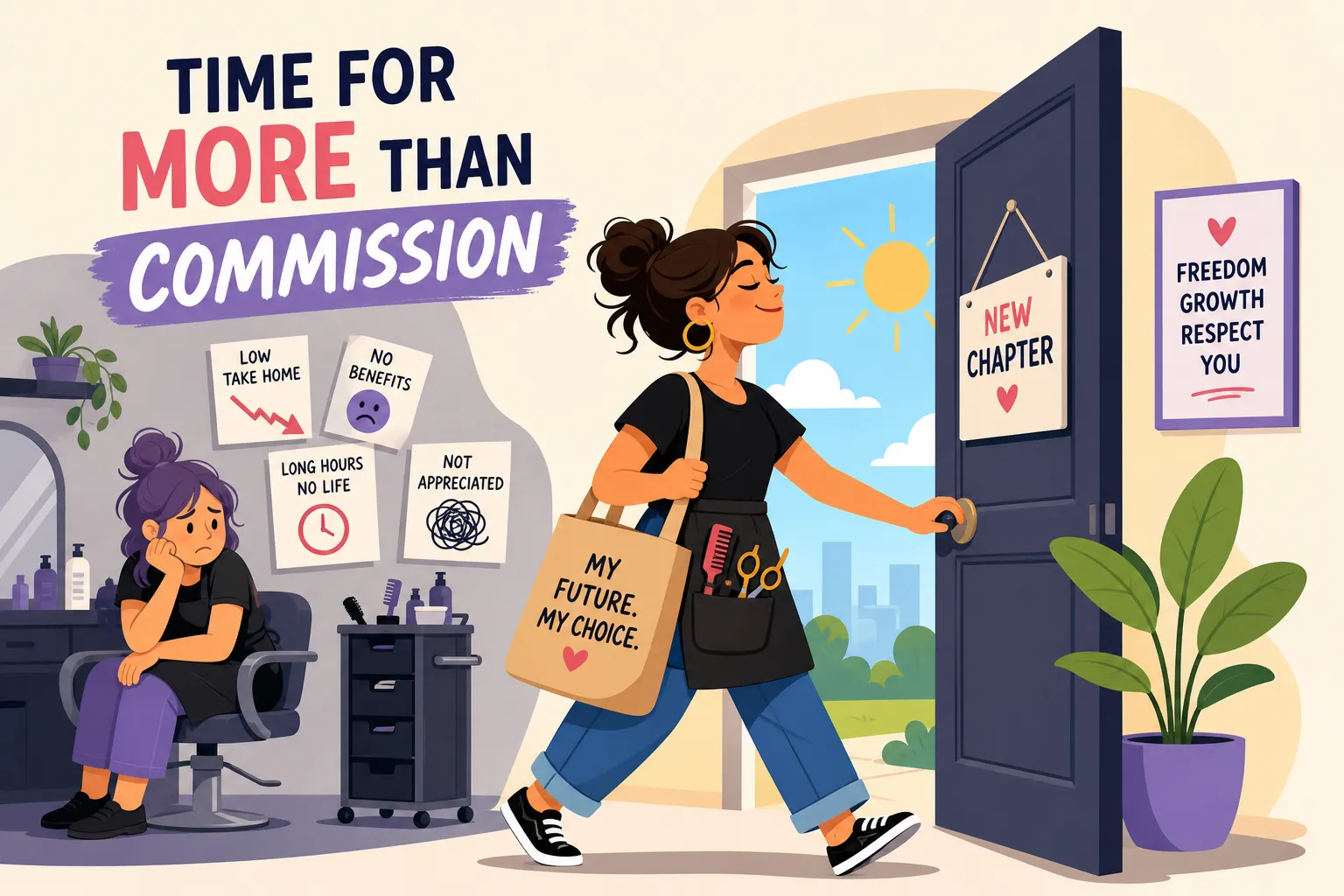
Most stylists don't leave in a moment. They leave in small, quiet realizations that stack up over months until one day the feeling is impossible to argue with. If you're recognizing the signs it's time to leave your commission salon, you're not alone, and you're probably not wrong.
If you're reading this, something probably doesn't feel right. That instinct matters, not because it tells you exactly what to do, but because it's usually telling you something true.
The signs that a stylist has outgrown a commission salon are rarely loud. They're consistent, low-grade, and easy to rationalize away, until they aren't. This article walks through nine of the clearest ones, the same patterns stylists describe when they look back at their commission years. If more than a few feel familiar, that's worth paying attention to.
The Commission Math Stops Working in Your Favor
In a typical U.S. commission salon, the house takes 40 to 60 percent of your service revenue. That means a stylist generating $5,000 a month in services takes home somewhere between $2,000 and $3,000 before any other deductions. This isn't a complaint. It's math.
The problem isn't commission itself. It's that commission structures are designed to protect the salon, and once you've built a solid book of business, the arrangement works considerably better for the salon than it does for you. Understanding when to leave a commission-based salon often starts here, with the numbers that don't add up anymore.
Sign 1: You've Stopped Understanding How Your Paycheck Is Calculated
Industry surveys indicate that roughly 31 percent of stylists cite pay confusion as their primary reason for wanting to leave a commission salon, not low pay, but confusion about pay. The opacity around service fees, product charges, and deductions is its own warning sign, separate from the actual dollar amount on your check.
When you can't explain your own paycheck, that confusion is a problem regardless of the total. Transparency is a basic condition of a working relationship, and when it's missing, trust follows.
Sign 2: You're Generating the Revenue but Not Keeping Pace with Your Growth
Most tiered commission structures are built with a ceiling. You work harder, build your book, grow your client base, and the salon benefits disproportionately from everything you've developed. At a 50/50 split, you're giving up half of every dollar you bring in while also delivering the service, building the relationship, and doing the rebooking yourself.
That's a lot to give up once the clients are genuinely yours. The structure made sense when you needed the support. It stops making sense when you've outgrown the need for it.
Sign 3: You Know What You Could Charge Independently
If you've started doing mental math around what you'd charge on your own, how much you'd keep, and what the difference looks like at scale, that's not daydreaming. It's an indicator that you've already started seeing the commission structure as a ceiling rather than a safety net.
Most stylists who've made the switch describe this moment as the beginning of the end of their commission years. The awareness arrives quietly, but it doesn't leave.
Signs It's Time to Leave Your Commission Salon: Schedule and Autonomy
Schedule inflexibility shows up in approximately 18 percent of survey responses as a reason stylists leave commission environments. But the real frustration isn't just about getting Sundays off. It's about who controls your time, your client flow, and your earning potential.
Sign 4: You Can't Accommodate the Clients Who Matter Most to Your Growth
Commission environments often require you to work assigned hours, take clients based on availability rather than preference, and seek approval before adjusting your book. That rigidity doesn't just feel inconvenient. It directly limits your income and your ability to serve the clients who are most loyal to you.
High-value regulars, clients willing to pay premium rates, clients who refer consistently, these are the people your business depends on. Not being able to build your schedule around them is a structural problem, not a scheduling inconvenience.
Sign 5: Requesting Time Off Feels Like a Negotiation You're Not Going to Win
Think about the last time you tried to take a week off during a busy season and how that conversation went. When your vacation requires management's goodwill, you're operating as an employee, not a professional building your own business. The distinction matters more than most stylists realize until they've experienced the alternative.
This is one of the quieter but more persistent markers. It doesn't show up in a paycheck, but it shows up in how you feel about Monday mornings.
Your Creativity and Career Have Hit a Quiet Ceiling
Exit interview data puts lack of career path as the top reason stylists voluntarily leave commission employment, cited by approximately 41 percent of respondents. This isn't about ambition in the conventional sense. Professional stagnation is a real cost, and it accumulates slowly enough that many stylists don't notice it until they're already halfway out the door.
Sign 6: You've Stopped Suggesting Ideas Because Nothing Changes
There's a specific moment many stylists describe: the moment they stopped pitching ideas. New techniques, service upgrades, pricing changes, none of it moved. So they stopped trying. That disengagement isn't laziness; it's the rational response to a structure that benefits from your skill without investing in your evolution as a professional.
When you go quiet in a creative profession, something has already been lost. The salon keeps benefiting from the skill while the person behind it stops growing.
Sign 7: The Environment Is Below What Your Clients Expect from You
When your reputation and skill level outgrow the physical space you're working in, clients notice before you say anything. You want to offer a premium, private, focused experience. The open floor, shared products, and salon's existing brand don't support that positioning, and the gap between what you're capable of and where you're doing it widens over time.
That mismatch is a pattern worth taking seriously. It means you've already moved past where you are, at least in the ways that matter to your clients.
Burnout Is Showing Up Disguised as a Bad Week
Stylist burnout signs consistently appear among the top reasons stylists exit commission environments. The tricky part is that this kind of burnout doesn't feel like collapse. It feels like a bad week, and then another one, until it becomes the default setting.
Sign 8: You're Exhausted in a Way That Rest Doesn't Fix
There's physical tired, which a good weekend can fix, and then there's the slower fatigue of doing excellent work inside a structure that doesn't recognize it. Stylists who've left commission environments often describe not realizing how heavy it had gotten until it was already gone. That weight is worth naming before it becomes normal.
If a full day off stopped resetting you months ago, that's not a rest problem. That's an environment problem.
Sign 9: You've Stopped Caring About the Salon's Success, Only Your Own Clients
This is one of the clearest behavioral indicators. You used to invest in the team, the floor, the culture. Now you think in terms of "my clients" rather than "our clients," and the distinction has stopped feeling like a slip of the tongue. It's become accurate.
That shift usually means the working relationship has already ended emotionally, even if it hasn't ended officially. Once that line is crossed, it's rarely uncrossed. The mind has already moved on, and the rest of the situation usually follows.
You're Already Thinking Like an Independent Business Owner
At some point, the internal shift from employee to owner happens before the actual move. This is the sign most stylists recognize most clearly in hindsight. It's less about what's wrong and more about what you're genuinely ready for.
When the Mental Math Switches
You start imagining your own space. You think about your own pricing, your own branding, how you'd communicate directly with your clients. This isn't idle fantasy; it's the mind preparing for the next stage, working through logistics before the body acts. Most stylists who've made the independent hairstylist transition say this mental switch happened well before they gave notice or signed a new lease.
How Stylists Like These Find Their Answer
When that shift happens, most stylists start asking what independent ownership actually looks like without the overhead of building a full salon from scratch. That search is how many of them find private suite concepts like Cosmo Salon Studios.
With multiple locations across Metro Detroit and Southeast Michigan, Cosmo offers fully equipped, customizable private suites where stylists keep their full revenue, set their own hours, and build their own brand inside a genuine professional community, without going it alone. The setup is designed to make the logistics of going independent manageable, with flexible move-in terms that reduce the financial pressure of starting out. You go into business for yourself, but not by yourself.
What Financially Ready Actually Looks Like Before You Walk Out
You can recognize all nine signs it's time to leave your commission salon and still not know whether you're positioned to act. That gap between recognition and readiness is where most stylists stall, so here are the honest benchmarks worth knowing before you make any decisions.
The Savings and Revenue Targets Worth Knowing
Most financial guidance for stylists clusters around three to six months of fixed costs saved before making the switch. In practice, suite rental tends to beat commission financially once a stylist is generating around $50,000 to $60,000 annually in service revenue. Below that threshold, commission's lack of fixed rent can feel like a buffer. Above it, keeping your full revenue in a private suite almost always wins, both on paper and in practice. To see where your own book lands, plug it into our salon suite calculator.
The Client Base Marker That Tells You More Than Any Number
A weekly book of 15 to 20 returning clients is commonly cited as the minimum foundation for a stable suite transition. But the raw count matters less than the quality of those relationships: clients who rebook without prompting, who've stayed through rate increases or location changes, and who are loyal to you specifically, not to the salon's name or convenience.
That distinction is everything when you're evaluating whether a move is premature or overdue. A smaller book of genuinely loyal clients often provides a more stable foundation than a larger book of casual ones.
Permission to Trust What You're Already Feeling
No single sign makes the decision obvious on its own. But when several of these feel familiar, not as passing frustrations, but as patterns you've been living with for months, that's not a bad week. That's a signal worth taking seriously.
Most stylists who've made the move say the hardest part wasn't the transition itself. It was giving themselves permission to recognize what they were already feeling and act on it. The logistics of leaving are manageable. The internal work of admitting it's time tends to take longer.
A Simple Leave Commission Salon Checklist Before You Decide
- Do you have three to six months of fixed costs saved?
- Are you generating $50,000 or more annually in service revenue?
- Do you have a weekly book of 15 to 20 loyal, returning clients?
- Have you researched suite rental costs in your area?
- Have you toured at least one private suite to understand what the setup actually looks like?
- Have you identified which clients are loyal to you personally rather than the salon brand?
Frequently Asked Questions
How do you quit a commission salon and keep your clients? Give adequate notice, communicate your move professionally, and where permitted by your employment agreement, let loyal clients know how to find you. Building a direct contact list before you leave, through rebooking conversations and your own social presence, is the most reliable way to carry your book into an independent setting.
How long does the independent hairstylist transition typically take? Most stylists plan their exit over three to six months. That runway allows time to save, research locations, tour suites, and quietly prepare without disrupting your current income.
What's the biggest financial risk of leaving a commission salon? Fixed overhead. Unlike commission, a suite lease is owed whether or not you're fully booked. That's why the 15-to-20 returning-clients benchmark and the savings cushion matter, they absorb the early months while your book stabilizes.
If these signs feel like your current situation, the next step doesn't have to be a leap. Start by exploring what independent work actually looks like in practice: tour a suite, run your own numbers, ask the practical questions. Reach out to the team at Cosmo Salon Studios to schedule a no-pressure consultation or suite tour. The signs it's time to leave your commission salon won't wait forever, but the decision can wait until you're ready to make it with confidence.
For Independent Beauty Professionals
The next step doesn't have to be a leap
Start by exploring what independent work actually looks like in practice: tour a suite, run your own numbers, and ask the practical questions.